

Portable Generators for Home, Job Sites, and Storm Season
Select Power sells and installs portable generators for homeowners, contractors, and anyone who has already sat through a week without power after a storm. Three different customers buy the same piece of equipment for three different reasons. The homeowner wants the refrigerator, the well pump, and a couple of window units running when the grid goes down. The contractor wants saws and lights on a slab before permanent power is set. The boat owner or camper wants an outlet that travels. Restoration after a major storm gets measured in days rather than hours, which is why a portable generator remains the cheapest way to cover that gap without committing to a standby system. What most people get wrong is not the generator itself. It is the connection between the generator and the house, and that is the part we handle as licensed electricians rather than as a retailer.
Generac Portable Generators and What Each Series Is Built For
Select Power is an authorized Generac dealer. Generac has built portable and standby generators in Wisconsin since 1959, and the reason we carry the line is repeatability: the same engine platform across the range, parts we can actually get, and a warranty process that does not strand a customer three years in.
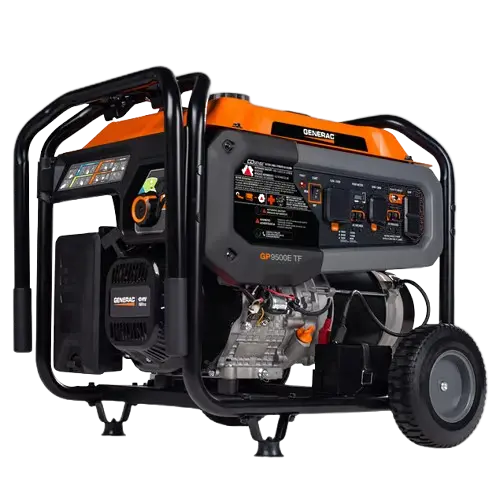
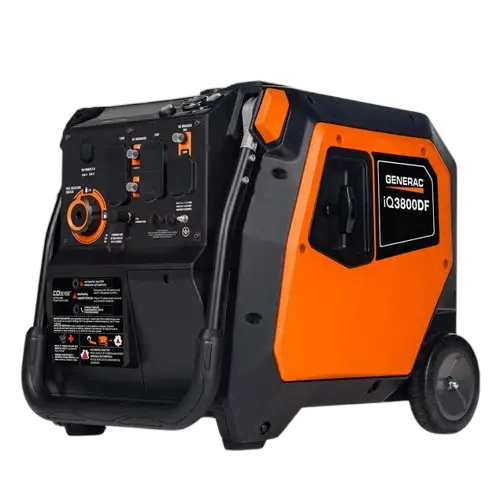
The GP Series covers the middle of the market at roughly 3,000 to 8,000 running watts, which is where the majority of home backup jobs land. Its PowerRush technology provides extra starting capacity, and that matters more than the spec sheet suggests, because a well pump or refrigerator compressor pulls several times its running draw for a second at startup and that spike is what stalls an undersized unit. The XT Series steps up in output and build quality for job site abuse and larger homes. The iQ inverter models run quiet and produce clean power suited to sensitive electronics, an RV, or a neighborhood where a loud engine running at 2 a.m. becomes its own problem.
Why Dual Fuel and CO Shutoff Matter on a Backup Generator
Every current Generac portable carries COsense, a built-in carbon monoxide sensor that shuts the engine down before levels in the surrounding air become dangerous. It is a genuine safety feature and it has saved lives, but it is a backstop rather than permission to run a generator anywhere near enclosed space. Dual fuel capability is the other feature worth paying for. Running on gasoline or propane sounds like a convenience until you have lived through a post-storm week.
Gas stations without power cannot pump, and the ones running on generator power have lines that stretch for hours. A propane tank you filled in spring is still full and still usable in the fall, while gasoline sitting in a can that long has usually degraded past the point where you want it in an engine you are depending on. That is the practical case for dual fuel, and it is why we steer most backup customers toward those models even when a single fuel unit costs less on the floor.
How We Connect a Portable Generator to Your Home Safely
Never plug a generator into a wall outlet to power the house. That practice is called backfeeding, and it pushes voltage back through your wiring and out onto utility lines where a crew working to restore your neighborhood has every reason to believe those conductors are dead. It is illegal, and it has killed linemen.
What our licensed electricians do instead starts at the panel, where we compare your service capacity and available slots against the generator's rated output so you know upfront how many circuits the unit can realistically carry. From there we install one of three connections. A manual transfer switch is the most common. A small subpanel feeding circuits you select in advance works well on larger homes. An interlock kit is the simplest option, a device that makes it physically impossible for the main breaker and the generator breaker to be closed at the same time. Generator output and the number of circuits you want backed up decide which one fits your situation.
Inlet, Circuits, Neutral Bonding, and the Permit
Once the transfer equipment is in, we mount a weatherproof power inlet box outside and wire it back to the panel. We seal and position these with humidity and salt air in mind, because a corroded inlet is a failed connection three seasons from now when you need it most. Your generator plugs into that inlet with a short cord, and no cable runs through a cracked window.We then land and label every circuit you want live during an outage: refrigerator, well or sump pump, a window AC unit, the garage door, and a bedroom circuit for fans and phone chargers. Those labels matter at 3 a.m. by flashlight.
We also verify whether your generator has a bonded or floating neutral and match the connection to it, since that detail determines whether the GFCI protection in your home still functions once you switch over to generator power. Last, we pull the electrical permit and schedule the inspection before you rely on any of it, which is the step DIY hookups skip and the reason those setups fail later.
What Your Neighbors Are Saying About Us
Areas We Serve
From city centers to surrounding neighborhoods, our team is ready to deliver dependable service right where you need it.

Bradenton
Longboat Key
Osprey
Siesta Key
Palmetto
Venice
North Port
Englewood
Punta Gorda
Arcadia
Tampa
St. Petersburg